
We don't hide our automation behind vague marketing. Here's exactly what runs in the background of every Tracx deployment, shaped around the way real freight operations actually work.
Matches drivers and equipment to loads based on real-time proximity, HOS availability, certifications, equipment compatibility, and historical performance.
Sequences stops, balances weight distribution, accounts for route constraints, and optimizes every load for revenue per mile rather than basic load order.
Plans fueling stops, mandatory rest breaks, and live traffic, while cutting deadhead miles and surfacing backhaul revenue opportunities automatically.
Ingests loads from EDI feeds, partner APIs, email rate confirmations, or a dedicated mailbox connector. Inbox to dispatched in minutes.
Geofence-driven notifications keep warehouses, internal teams, and customers informed at every waypoint, delay, and route change, all without dispatcher intervention.
Trained on real-world logistics data and your own operational patterns, Tracx gets loads out the door on time. Your dispatchers stay focused on the calls that actually need a decision.
13-month lookback on your own historical data, surfacing per-load margin against your actual lane performance. Your numbers, your lanes, your pricing decisions.
Flags load problems, route deviations, count discrepancies, and condition changes the moment they happen, before they become claims or missed deliveries.
Welfare clocks, HOS windows, temperature reports, certification expiries, and USPS compliance scoring, tracked automatically in the background.
Temperature reports, scale tickets, and BOLs auto-generate and attach where they need to go. Invoices, portals, compliance files, one source of truth.
Fraud and double-brokering checks run automatically at every carrier assignment, protecting margin and reputation without slowing down coverage.
Specialized integrations automatically calculate permit costs at load creation for accurate quoting and intelligent planning.
Every freight type has its own compliance demands, billing quirks, and dispatch rhythms. Tracx is shaped around all of them.
The math on a TMS isn't just about what it costs, it's about what it earns back. Tracx automation pays for itself in three directions at once.
Cut deadhead miles, eliminate manual data entry, reduce detention from late dock notifications, and catch cargo issues before they become claims. Tracx customers report an average of 30 minutes of dispatcher time saved per load.
Dispatchers don't have time to analyze every lane, so Tracx does it in the background. Backhaul opportunities, consolidation chances, lanes that quietly shifted in profitability. Your team sees the opportunities that used to slip by unnoticed.
Fraud detection for brokers, compliance automation in livestock and cold chain, certification matching in specialized hauling, and on-time scoring in USPS contracting. Every claim you don't pay, every contract you don't lose, that's automation earning its keep.










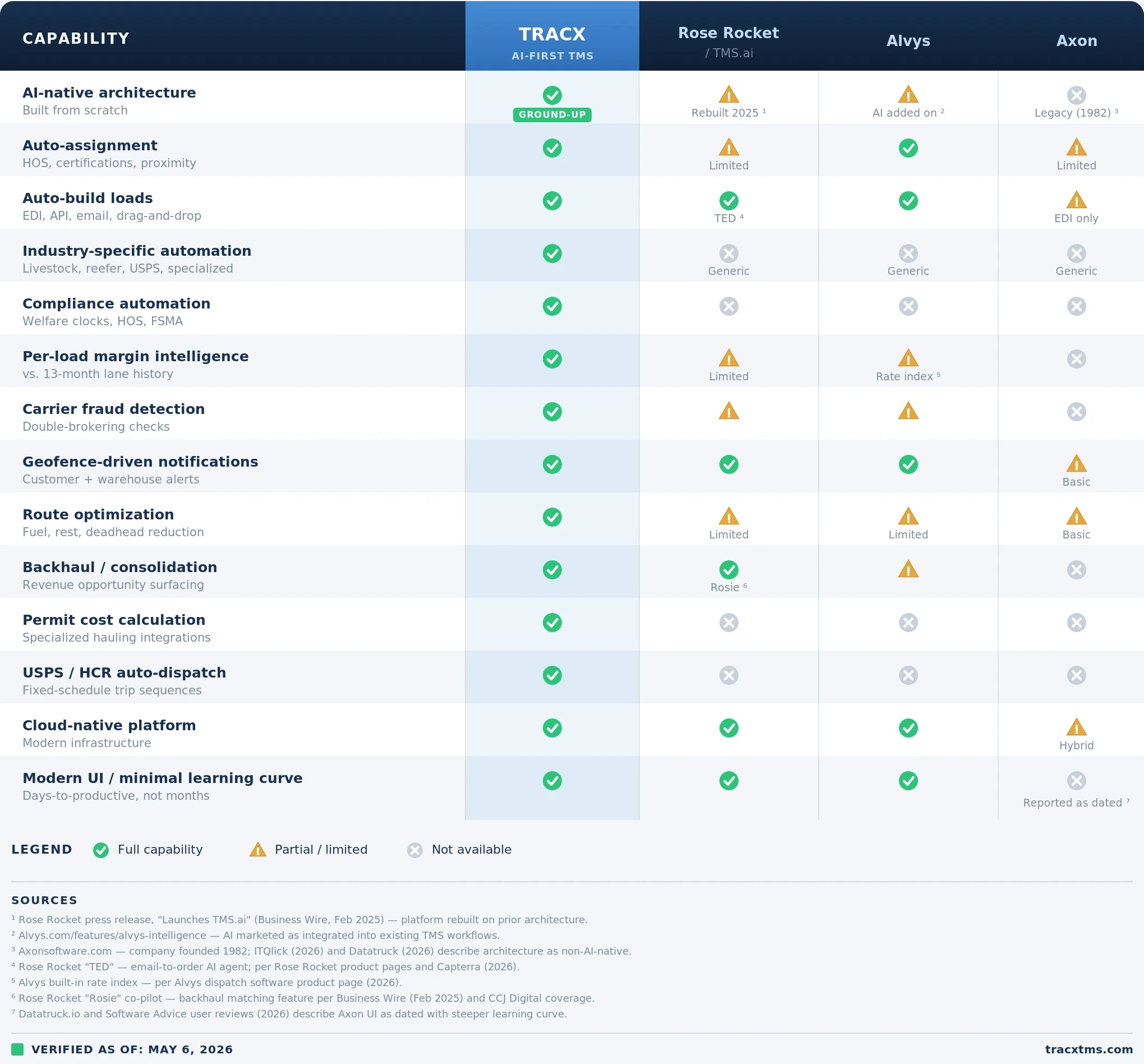
Most TMS platforms arrived at AI the same way. They duct-taped it onto infrastructure that existed long before AI was a serious tool. The result is automation that lives in a sidebar: a recommendation engine that can't see your lane history, a chatbot that doesn't understand the difference between a livestock welfare window and a reefer temperature profile.
When AI is native to the foundation from day one, it has full context: the load, the driver, the lane history, the compliance windows, and the equipment status, all in one place, updating in real time. It learns from your operation specifically. And it doesn't start life buried under decades of decisions made for a different era of software.
Tracx started from a blank canvas with intelligence at the core. No rebrand, no add-on layer, no workarounds. That's the difference between a TMS with AI features and a TMS that is AI-first.
"The result is a TMS where automation isn't a marketing checkbox. It's the operating system."
A straight-talk comparison against the platforms you're most likely also evaluating.